Monday, May 2, 2011

Interview with Stephanie Bella

This interview was conducted on February 26, 2011 in the kitchen of Stephanie Bella’s home over a perfectly brewed pot of coffee.  Full disclosure on this interview, she is my younger sister, for the purpose of the interview I asked her to pretend we were not related and that I did not know her back story.  I choose to interview her because we were both taught as kids the same valuable lessons of farming, gardening and preserving a harvest and knew this would be valuable information for my research topic.

Christina Todd: Tell me how the garden started.
Stephanie Bella: We are poor, we both work two jobs and can never seem to get ahead, and we had cut our budget time and time again and still couldn’t find the money to pay for everything.  I was having a really bad day after making another call to another utility company begging for more time to pay the bills.  I was crying at our patio door when it dawned on me, I own land, I know how to work land, I know how to grow things and preserve things, I am totally going grow stuff as much as I can to help with our grocery bill this summer.
CT: How did you know how to do these things?
SB:  My grandma taught me.  I grew up on an apple farm in California, farming is in my blood.  My grandparent’s land produced so much food.  There where berry bushes, plum trees, orange trees, lemon trees, a huge garden was planted every year, there was an herb garden and when I was about 12 they even installed a green house to continue to grow through the whole year.  I can jar with the best of them, make strawberry jams and syrups, all sorts of good stuff.  It was weird when I was old enough to be in school and realized that most of my classmates didn’t do any of this stuff.
CT: How did you start?
SB: I have Scott (her husband) remove all the sod on the left hand side of the house and just started growing stuff, before I knew it I had kind of an obsession going.  After the first year we put in the berry bushes and the fruit trees and I packed every space I could with a food producing plant.
CT:  How much does this really help you, is it really worth the time and energy?
SB: For sure.  Don’t get me wrong, we still struggle, especially in early spring when the harvest runs out and the new one has yet to be produced, buy my grocery bill certainly feels relief at harvest time.  We even compost our own stuff now, I feel good about that, it makes me feel very environmentally savvy.
CT: Tell me about your homemade baby food.
SB: I make my own baby food with fruit and veggies from my garden and a food processor, I pureed tons of vegetables and fruit from our garden last year and froze them, and that is what Charlie has been eating since he started on solid foods.

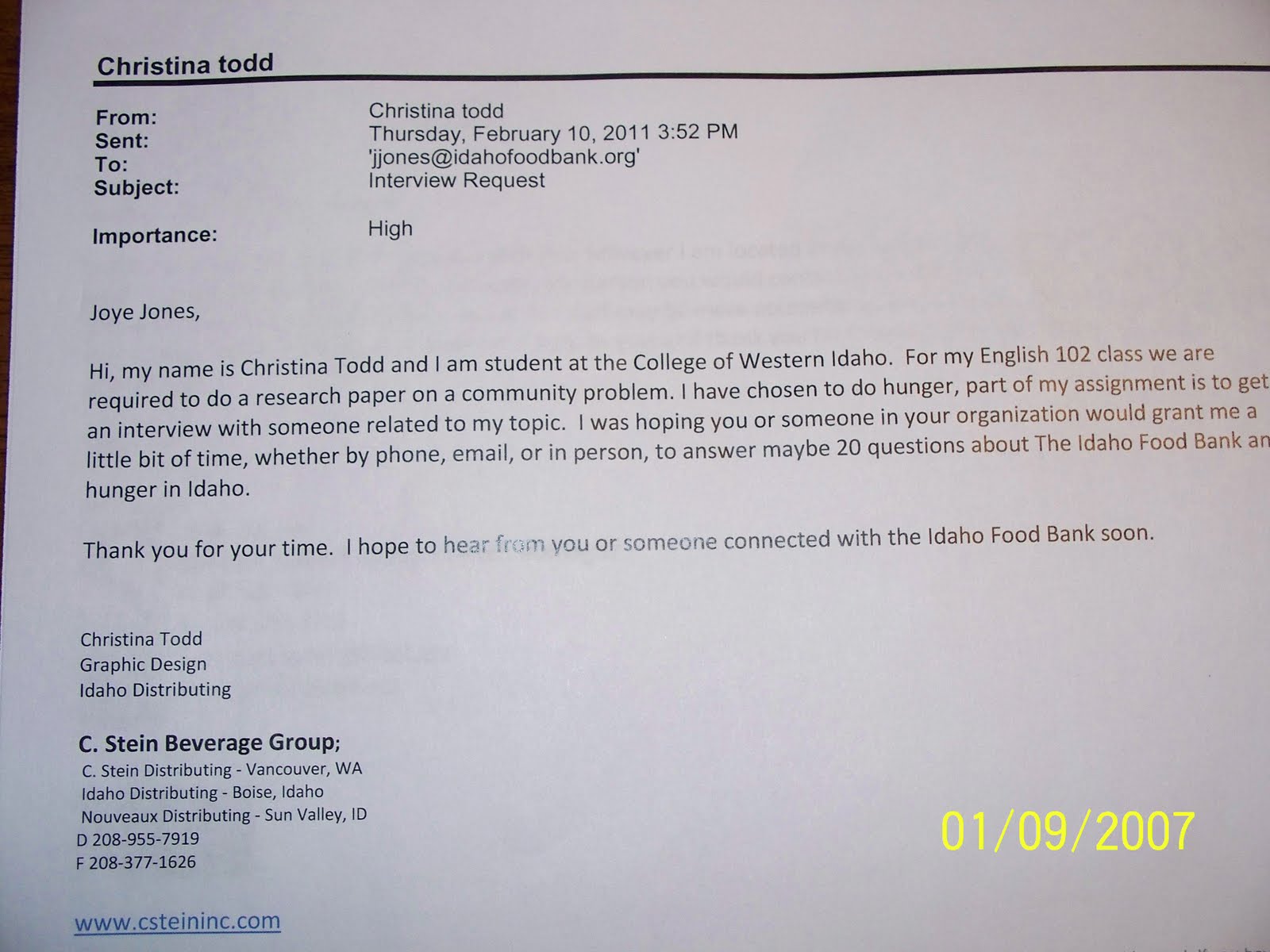
Letters of Inquiry

Please for give the picture of the email print outs, I could not for the life of me figure out how to publish a pdf file to my blog.

Film Analysis: The Grapes of Wrath

Christina Todd
Eng034w
Film Analysis
March 20, 2011
The Grapes of Wrath
Between the years of 1935 and 1940 thousands of farmers and their families were forced off their farms in Oklahoma, Texas, Arkansas, and Missouri onto Route 66 in search of the land of milk and honey: California. They followed the road searching for the promise of jobs, higher wage and a better life after banks began forcing them off their land that they had lived and worked for the last fifty years or more.  Families ripped from their roots, with no place to call home, Okies as they became dubbed, found themselves on the long stretch of highway with empty stomachs and empty pockets (OKSTATE).   In 1939 the world was introduced to the Joad family through John Steinbach’s Pulitzer Prize winning book, The Grapes of Wrath.   The Joad family came to represent the hundreds of thousands of people thrown off their land and forced to chase a better way of life in California, a “simple and uncomplicated” (BEACH) story.   In his essay, The Grapes of Wrath: A Novel of Mankind, Akira Nakachi discusses the two stories being told “on one side a tragic story of the migrant laborers driven on by antagonistic forces of nature and the social system till death stares then in the face, and on the other it is a forceful story of the migrants going forward over a number of obstacles” (NAKACHI}.  The book evokes sympathy and anger in its audience  as you read about the Joad’s  sole quest to find honest work in order not to starve, you feel compassion for them and for every other family who had to do through this American tragedy, could a 128 minute film based on the book bring those same feeling to its audience?
In 1940 John Ford held the dubious task of bringing John Steinbeck’s heart wrenching epic tale of the Joad family to life on the big movie screen.  The Grapes of Wrath stared Henry Fonda as Tom Joad who is the strength of the Joad family. “He is a man of action. He does what he thinks is right and never regrets what he has done” (NAKACHI).   He is smart, but quick to anger, he sees the situation for what it is, he is not a dreamer, and the entire Joad clan relies on his knowledge to get them through.    Jane Darwell won the 1941 Academy Award for best supporting actress for her portal of Ma Joad the family matriarch and the glue that tried desperately tried to keep the family together.  The character of Ma Joad is a tribute to all the strong women who kept their families together through death, hunger, and circumstances beyond their control.
A freshly paroled Tom Joad returns home after a serving four years in prison for homicide.    He discovers his family farm, along with those of all their neighbors, have been reposed by the banks.  He arrives just in time as his entire family is set to leave for California the very next morning. In their old run down jalopy packed to the sky with family and belongings they travel Route 66 on their way to California with a flyer tucked in their pocket promising jobs and good wages.  The movie tracks their travels to California as they encounter death and hunger, the camps and places along the way, the disappointment of the land of promise as they find themselves in transit camps and exploited for little pay by wealthy ranch owners, and the contempt and prejudice of  native California’s who don’t want them there.   Tom watches as his family falls apart and vows to take up the cause of his people. The movie closes with what is left of the Joad family back on the road following yet another promise of work (ERICKSON).
A series of three flashbacks narrated by a Muley Graves (John Qualen), a local crazy man so connected to his land that even after his family has left he stays prowling the deserted farms like a ghost, to tell the story of the evictions taking place across the state. In an eerie candlelight scene, which for seconds at a time go black, Tom and Jim Casey (John Carradine) coroner Muley demanding to know what is going on. The sound of wiping wind is heard in the background as Muley tells of dusters, notices, bankers, and caterpillar tractors. As Muley talks the screen shows several caterpillar tractors driving over dust blown farms and the sound of loud creaking tractors engulfs the audience eardrums, it resembles a march of destruction.
Ford uses filming effects like candlelight lighting, a moving score, a powerful panning shot,  cryptic sound effects,  and wonderful dialogue given by Ma Joad to tug at the heart strings of the viewing audience as the Joad’s say goodbye to the only life they have ever known.  It is early in the morning, the sun has yet to rise and Ma Joad is sitting in the run down farm house all alone, the only light is coming from the old stove fire she is sitting in front of, this fire illuminates her face and little more. A sad accordion version of Red River Valley begins to play as she opens a small box next to her and begins going through its contents.  The song moans on as she picks each item from her past up and holds it in the light, a small smile comes across her hard face as she looks at mementos from her past, one of the only times she will smile through the whole movie.   The final scenes at the old farm seem to be pulled from old photographs; it is a head on shot of the running jalopy packed with the whole Joad family. Their rundown sad farmhouse is in the background, the truck pulls out of the frame, the viewer is left looking at the front of the house. The screens are ripped, the door is open, and there is trash everywhere.  This still frame leaves little doubt to how poor this family really is.  Suddenly you begin to hear the wind start blowing, softly at first, but then it begins to roar, you see it on the screen as a dust ball bounces through followed by a piece of news paper.  The ratty old door begins to bang back and forth, bang, bang, bang.  The camera pans to the left, we see the old jalopy headed down the dusty road, the accordion score of Red River Valley starts up again, the audience can still hear the wind and the banning of the door: bang, bang bang. Cut to a three-shot of the truck’s cab.  Al, Grandma, and Ma Joad are driving away.  Ma Joad is sitting tall with a hard stoic look on her face, she is staring straight ahead, and a stirring dialogue takes place between her and Al over the sad droning of the accordion:
AL :( grinning) Ain’t you gonna look back, Ma?--give the ol' place a last look?

MA JOAD :( coldly shaking her head) We're goin' to California, ain't we?
      Awright then, let's *go* to California.

AL: (sobering) That don't sound like you, Ma. You never was like that before.

MA JOAD: I never had my house pushed over before. I never had my fambly stuck out on the road. I never had to lose... ever'thing I had in life (FORD).

Through his direction and great acting Ford is able to make his viewers feel the pain of saying goodbye, equal to that of the book. As a viewer you are connected with this family’s struggles and when it dawns in you that this family represents thousands you feel anger, but like the characters of the movie you too wonder who to direct this anger to.
               A montage is used to show the rattling jalopies travel toward California. A US Highway 66 appears on the screen. Superimposed behind it is a montage of
The Joad’s weighed down jalopy moving through farm land and cities. The signs of towns on U.S. Highway 66 fade in and out—Sallisaw City Limit, Checotah, Oklahoma City, Bethan, Peso River, New Mexico.  Ford breaks up the montage to pull a couple  . . .
               In the second half of the film John Ford spends the time introducing the audience to three very different migrant camps in California.  He is showing us that upon arrival the Okies had three choices despair and hunger, tyranny rule, or if lucky enough to find a free space a government run camp.
               The first is the Hooverville Transient Camp, two miles outside city limits, clearly these people are unwanted.  Using subjective view, Ford has the audience staring out the windshield from behind the wheel of the Joad’s old jalopy as it rattles its way through the crowded camp.  Hungry and emaciated faces stare back at the viewer as the jalopy weaves through dirty tents and huts.  The faces staring at you move slow, sometimes crossing the path of the jalopy, all faces are staring, none are happy, it looks like a city dump full of people.  The feeling viewers get is that they have just rode through utter hopelessness, filth, and disillusionment. Through the subjective view you see the peoples hunger and despair.
               The second camp visited is the Kenne Fruit Ranch. This camp is representative of all the evil rich ranchers who exploited the tens of thousands of homeless and hungry Americans who were willing to do anything just for food.   The scene is set so viewers know something wrong here; the camp gated and guarded by armed men, cops and yelling Okies line the road leading to the main gate. Again Ford uses subjective view to put the viewer in the driver’s seat of the jalopy as it is police escorted through the line of migrants and armed guards lining the side of the road.  Like the Joad’s the viewers don’t know what the commotion is about, but something about this scene seems really wrong.  Still using subjective view through the dirty windshield you see a migrant worker break free from the line, he is yelling, but like Tom Joad, we can’t hear what he is saying we only see him dragged back by more armed men.  This camp is made to resemble later images of concentration camps, Ford focuses the camera on the hungry group who swarm the barbered wired gates after the Joad’s jalopy has passed through.  The children’s little hands grasp through the chain link holes, they stare after the line of dusty cars, Ford focuses on the face of a young girl in a close up shot, the viewer’s like the Joad’s still don’t know what is going on, Ford makes it so you are herded along with the family to a dirty house, told to shut up and pick fruit and don’t ask questions.  In almost every scene shot inside this camp a man can be seen holding a weapon, the men are short in tone and have a take it or leave it manner, by their expressions you know that they don’t’ care one bit about these starving families, if they won’t work for their low wages there is a line of starving people that will. 
               An  establishing shot of the sign welcomes the Joad’s to the Farmworker’s Wheat Patch Governement Camp. The camera closes in on the sign hanging underneath the camp name, it reads Department of Agriculture. This is the first camp that Ford does not use subjective view; he wants us to read the Joad’s faces as they finally find a place where they are welcomed.  They are very weary of the camp’s director, who is dressed in bright colors, he has a smile on his face, and he resembles Franklin Delano Roosevelt, the man who would eventually help America out of the depression.  In contrast to the other camps, everyone here looks healthy and many smiles can be seen on the Okie’s faces.  Children run happy and healthy; viewers are left wondering why there aren’t more camps like this one?
Sadly the massive scale of suffering in the book is absent in the movie.  I had never seen the movie before this, but I had read the book several times over my life, as it tells part of my family’s history.  When I chose the topic of hunger I knew there would be no better movie to watch then this one, based off my knowledge of the book, I was wrong.  While Ford shows some struggles of the migrant worker, in the transit camps scene and in a story told by a man in a highway camp about his children who died with bellies swollen from hunger, he doesn’t delve into how bad the situation really was.  Families piled on top of each other, floods and rains, abandoned barns filled to the rafters with families hungry and cold and dying.  Ford’s adaptation of the film ends on an upbeat note, the family is headed towards twenty days of work and things are looking up, Ma Joad delivers the famous line, “That’s what makes us tough. Rich fellas come up an’ they die an’ their kids ain’t no good, an’ they die out. But we keep a-comin’. We’re the people that live. They can’t wipe us out. They can’t lick us. And we’ll go on forever, Pa . . . ‘cause . . . we’re the people” (FORD).   Yet the end of the book tells a very different tale. The Joad’s are broken, on the verge of death and barely hanging on. They are headed to an abandoned barn in need of some shelter from the flooding, a man inside is dying of starvation, one of many heart wrenching scene of despair absent from the movie.  In leaving these miserable conditions out of the movie, John Ford has done a disservice to the history of the Okies.   Not only do we as viewers miss out on the intense suffering, but we also miss out on how amazing these people where, who fought dust bowls, tractors, prejudice, hunger, and death.  For those wanting to know what is was really like for the Okies read the book, for those who want a happily ever after, stick to the movie, just remember a greater story of survival lies just beneath it’s surface. 


Cited Works
BEACH: Joseph Warren Beach, “John Steinbeck: Art and Propaganda,” Steinbeck and His Critics.  (Albuqueroue, 1956). P.252
DIRKS: Tim Dirks. “The Grapes of Wrath (1940)”. Filmsite. 2011. Web. 9 Mar. 2011.
ERICKSON: Glenn Erickson. “The Grapes of Wrath Review”. DVD Savant, 24 March. 2001. Web. 14 Feb. 2011.
FORD: Grapes of Wrath. Dir. John Ford. Perf. Henry Fonda, Jane Darwell, and John Carradine.  Fox Home Entertainment., 1940. DVD.
NAKACHI: Akira Nakachi.  “The Grapes of Wrath: A Novel of Mankind” Page 47-61. Print.
OWEN: Louis Ownes. “The Culpable Joads: Desentimentalizing the Grape of Wrath”.  Critical Essays on Steinbeck’s The Grapes of Wrath, edited by John Disky, G.K.  Hall. 1989. Print.
STEINBECK: Steinbeck, John. The Grapes of Wrath. New York: The Viking Press, Inc. 1939. Print.

American Factory Farming Will Not End World Hunger


Christina Todd
ENG 102
Final World Essay
May 1, 2011
American Large Factory Farming Will Not End World Hunger


                This report looks at how United States backed, and many times forced, policies of large factory like farming is hurting the war on ending global hunger more than helping it.  Bad trade policies and bad farming incentives had lead to the poor in second and third world countries relying too heavily on the super powers of the world to save them from starvation.


Christina Todd
ENG 102
World Essay
April 16, 2011
American Large Factory Farming Will Not End World Hunger
                Lochoro is a mother of five young children who lives in poverty stricken Uganda. It is well past mid morning and she has yet to cook a single thing for any of her children or herself.  “I don’t even know what the kids are going to eat,” she says as she beings her never ending quest to make enough money to feed her children one good meal a day.  If she is lucky she will earn .25 from selling things like water and firewood to people in neighboring villages, to buy enough rats to feed her children and herself.    “I smoke the rats cut them into pieces, and fry the meat — or boil it if I don’t have cooking oil,” she boast of her culinary skills (WORLD VISION). Sadly Lochoro’s plight is not very different from a lot of people in the world. Every 3.6 seconds someone around the world dies of hunger.  925 million people went hungry in 2010.  Every year 15 million children die of hunger.  These are overwhelming statistics for a world that  according to the Bread for World institute produces enough food to feed every human 4.3 pounds of food everyday worldwide - “enough food to make most people fat” (WORLD HUNGER).  In 1996 leaders of 185 nations met and pledged to one another and the world to cut those suffering from hunger in half by 2015, a far cry from their 1986 pledge to eradicate world hunger completely. In a follow up meeting held five years  later, in 2001, to track their progress  those same nations met again in Rome only to realize they  had yet again aimed too high as they found they were two-thirds short of where they needed to be to reach their 2015 goal (MOORE).  With yet another  massive failure of goals on their hands it is time for those in charge of helping to feed the world, lead by the United States and Europe, to take a step back and realize their policies and plans for eradicating hunger world wide are not working.  The idea that American big farming is the answer to the world’s hunger problem has been proven more of a cause of world hunger then a solution by killing small and family farms all across the world and a big business monopoly in the world’s food system which has created trade policies that pit small local farms again large factory farms.  These policies are causing a destructive and massive food crisis across the globe.
                Governments of the world have been promising to end hunger for the last three decades with very little success to show for it.
  • 1974: 500 million people were going hungry in third world countries.  The World Food Conference plans to end hunger in ten years.
  • 1996: 830 million people are going hungry. The World Food Summit plans to reduce the hungry in the world by half.
  • 2000 Millennium Summit.  Same pledge to reduce poverty by half is pledged.
  • 2002: 850 million people are going hungry in the world. The World Food Summit commettiee has to admit that their Millennium Development goals are far behind of where they thought they would be at this point.
  • 2008: 862 million people are going hungry in the world.  Hunger has increased; over three billion people live on less than $2 a day (HOLT-GIMENEEZ).
America has played a large role throughout history in the world’s fight against hunger beginning with the American Relief Administration which was created shortly after World War I their job, according to Ryan Swanson’s 2004 article for the AgExporter, was to provide and distribute food and supplies to the starving people of Europe.  Since the creation of that program United States involvement in the world’s food aid has continually increased and evolved as the need for aid has continued to change. The end of World War II brought the Marshall Plan, which gave Japan and Western Europe almost 13 billion dollars in food and aid these war torn countries to rebuild their cities and economies.  Through this program the United States government gained the knowledge and experience in how to distribute food and funds to the needy people of the world.   The Garnett Plan was the first major misstep in the United States plan to end hunger. The brain child of an army officer by the name of Gwynn Garnett, this policy would forever change the way the United States gave aid to other countries. The concept was simple; the United States would sell their surplus agricultural goods to struggling countries by accepting foreign currencies in exchange.  57 years after the Garnett Plan was approved by congress it is still the blueprint for all aid given to foreign countries (SWANSON).  Untied States Government supported polices like that of the Garnett Plan have lead most southern second and third world countries to be less self sufficient as they rely on the globalized food market which favors export of their crops, import of cheaper crops, and the idea in the United States that big farm factories to feed the world is the way accomplish the World Food Summit’s goal (SULLIVAN).  Those who back these ideas couldn’t be more wrong.  
                Large American farms are not the answer to the world’s hunger problems, but those representing America and its policies think different, even though they have been proven wrong time and time again.  At the 1996 World Food Summit in Rome the U.S. Secretary of Agricutlure, Dan Glickerman, informed the world not to worry about growing their own food that the United States farmers would and could grow food for the entire world (BELL).  His American backed policy suggested that farmers in third world countries abandon their farms and move into busy cities to work in manufacturing plants building things to export to pay for the food American farmers would produce.   This policy is asking countries to abandon their agricultural roots and rely soley on somelse to feed them.    This a ridicules notion how can a country learn to produce food for itself and sustain self sufficient economies if it is relying on its most basic need, food, from anywhere but its own land and people.  Dambisa Moyo is a Zambian economist who wrote a very controversial book on this subject called “Dead Aid.”   In this book she looks at the relationship between aid and how is undermines growth in Africa. Moyo say the that aid doesn’t work because “the economies of those countries that are the most dependent on foreign aid have shrunk by an average of 0.2 percent per year ever since the seventies” (MAYO).   United States policies force other nations to take our surplus and give up any food self reliance of their own. 
                This idea that big farming is the cure to all that hails world hunger is not only hurting the country that it has set out to help, but is also causing major changes in the agricultural landscape of the United States and the world market.  In the last 50 years United States farms have dropped from six million to less than two million, while the amount the large farms are producing has increased at the fast pace (BELL).  The small farms and family farms are finding it harder to compete with large factory like farms.  The U.S. Farm Bill has done little to stop this trend as it encouraged farmers to grow “fence row to fence row” (HOLT-GIMENEZ).  This policy has killed local farming in poor countries they cannot compete against the large farms of the western world.
Thanks to unbalanced trade policies, that favor the few and damage the majority, the world food’s system is now controlled by an agricultural monopoly made up of a three very powerful companies: Cargill, Archer Daniels Midland, and Bunge.  These companies continually back policies that favor their bottom line like the Structural Adjustment Program, which was responsible for the introduction of dumping (HOLT-GIMENEZ).   Dumping is when the large grain producing companies decide, because of low grain prices, to sell their surplus gain to poor countries at a price way below local value in both second and third world countries (PARKER).  Small farms in the south cannot compete with that kind of competition and soon find themselves unable to make a living on their crop, unable to pay they will find themselves landless and penniless with no way to feed or support their families, soon they too are relying on the cheap grain that made them penniless in the first place.  These companies, along with some of their partners, have seen profits rise by over 100% because of policies which that aid them in dumping.  Dumping refers to when large amounts of cheap grain at dumped into countries undercutting local farms, when they do this the take away the livelihood of many of the poor of the world (BELL).
The truth of the situation is that American backed policies will always favor America’s bottom line even when hidden behind the act of doing good.  Until the poor of the world are able to grow, produce, and save their own food they will never be free of hunger.  History has proven time and time again that the only way to make countries self sufficient is to allow them to grow their own food which in return will grow their own economies.


Works Cited
BELL: Bell, Janet. “Will the U.S. Breadbasket Last?”  Seedling. Dec. 2007. Web.  28 March. 2011
HOLLT-GIMENEZ:  Holt-Gimenez, Eric.  “The World Food Crisis: What’s behind it and What We Can Do About It.” ALAI, America Latins en Movimento. 24 Nov. 2008. Web. 10 March. 2011.
MOORE: Moore, Melissa. “The World Summit: What Went Wrong?” foodfirst.com. Institute for Food and Development, 11 Feb. 2005. Web. 5 April. 2011.
MOYO:  Moyo, Dambisa. Dead Aid: Why Aid is Not Working and How There is a Better Way for Africa. Farrar, Straus and Giroux, 2010. Print.
PARKER: Parker, Elizabeth.  Letter to Warren Staley, CEO of Cargill, Inc. 21 March 2010. www.foodfirst.org.  Web. 5 April, 2011.
SULLIVAN: Sullivan, Thomas.  The Current Status of World Hunger. GEO. 15 July. 2010. Web. 13 April. 2011.
SULLIVAN: Sullivan, Thomas
SWANSON: Sawnson, Ryan. “Fighting world hunger: U.S. food aid policy and the food for peace program.” AgExporter. Oct. 2004. Web. 5 April. 2011.
WORLD HUNGER:  World Hunger. 2011 World Hunger and Poverty Facts and Statistics.  2 March. 2011. Web. 10 March 2011.
WORL VISION:  www.worldvision.org

English 102, Wow.

Christina Todd
ENG 102 034w
Semester Reflection
May 1, 2011
English 102, Wow.

Wow the end of my first semester in college is here.  Wow.  Taking into consideration the fourteen year lapse from my 1997 high school graduation to now I think I did pretty well, despite the grueling amount of work, desperate count downs to deadlines, and a complete mental breakdown on the discussion board one frightful afternoon my ship is now coasting safely to the harbor. 
                I have learned a lot about myself in these past weeks. One major thing being that I am a very self-centered person, something I wouldn’t have believed at all before my journey of discovery.  It all started the first day I opened up the dreadful MDG’s.  My first thoughts as I read through our list of research topic choices was, you have got to be kidding this lady wants us to solve the world’s problems in this class and I said it out loud to my 15 month old son who was watching Toy Story next to me in bed..  I thought to myself these are fresh out of high school college kid’s topics.  I don’t care if people starving around the world, I am trying to keep my own family nourished with rising gas prices and food prices and no salary raise in four years working against me.  Now as I look back I wonder how self centered could I have been, now that I have read too many stories of hunger here in Boise, here in the United States and around the world.  Women trying to scrape together a dollar a day to buy rats to feed their children, families displaced by natural disasters beyond their control, children dying by the minute and here I am saying I don’t care cause I need to figure out how I am going to pay for my cable and still have money for full course meals at home.  Beyond the personal enlightenment I have found that I learned how important it is to sound intelligent, even if it is a quick email to a co-worker.  I have learned how to breakdown writings and analyze them for my purpose, a piece of writing might not tie in totally with what I am researching, but one little nugget of information could open a flood gate of ideas you just need to know how to look for it.  The most important skill I learned was how to research.  I have been putting my new research skills to work in both my professional and private life as I search for new graphic printers and daycares.  I leave this class with the knowledge that a little hard work will lead to wonderful mind opening discussions and knowledge. 
I felt myself grow in this experience.  I started off unsure of how to write intelligently yet keep it interesting, I think now I have found a good balance.  My first reading response was an over thought out and over work sited bore about BPO’s in India.  My final reading response about Michael’s Berube’s essay  Analyze, Don’t Summarize I analyzed less and wrote freely which lead to a much more enjoyable piece to read.  This class has also strengthened my researching skills, well to be more accurate it developed skills I never knew where important.  Research makes you knowledge able about any subject you wish wither it be crabs, pigeons, or politics.  It gives you the tools to discuss why something means so much to you.  You have a better chance of getting someone to listen to your ideas or needs or thoughts if it is backed by strong research. 

                I also learned from this class that I need to work on many things.  Spelling and proofing, rambling on and on, and the biggest procrastinating.  I am a terrible speller, I always have been and always will be, and not running spell check before I send out any sort of document be it report, email, or news letter is an unacceptable lazy practice.  I am trying desperately to spell check and proof read before I hit send on any piece of writing that has my name attached.  Sometimes though my hand moves faster than my brain and I hit send before doing this ever important step.  I also tend to ramble in my writings, I try to tone it down, but continually have to read and read stuff to make sure it makes sense, I would like to be able to control my thoughts better in a more intellectual and flowing way.  Something I am despartley needing to continue working on is deadlines and procastonating.  To be honest this essay is do today and I am just now finishing it up, not very good for ones mental state.   Self disapline is the only way to achieve this goal. I start off a week with good intentions of doing at least an hour to two of English work a day, but the day would get away from me and I would continulay put off finishing project until it’s due date stared me in the face.  Towards the end of this class all the procrastinating caught up with me and I missed three deadlines, not something to be tolerated and I was disappointed in myself. 
                I have been using my new found research skills in so many areas of my life it would be easier for me to tell you where I am not using it.  I enjoy watching news and especially love politics and before this class my alliance was to MSNBC and no one else, but that changed with this class.  I started incorporating Fox News into my nightly news watching because I wanted to know what they were thinking as well and many times I found myself at the computer to research who was closer to the truth of the subject they had chose to cover that night.  In my personal life I have my research skills to find a good daycare for my son.  First I chose all that were within ten miles of our home, then researched each, from there I narrowed the choices down, I went for a drive by of each, the group got smaller, then I interviewed and toured each and finally chose a winner.  Jack starts at Peirce Park Academy for two days a week starting Thursday.  In my professional life I found research most useful in getting the graphic printer I wanted most.  Every four years my company budgets for me to get a brand new graphics printer.  This year, unlike pervious, I had to fight with the money crunches to get the one I wanted.  They wanted a less expensive one that also was way below the quality of the one I was desperate to get.  In the end I won thanks to my English 102 research skills.  I worked and laid out a presentation backed by facts and pictures to get my machine in here. 
                For the most part this was a very rewarding experience, crazy at times and pushed to the brink on others I found out a lot about myself what I am good at, what I need to work on, and how to take a step out of my world and peer into others.  I guess this is what high learning is all about, finding yourself, finding your weaknesses and strengths and taking all this knowledge with you out into the big bad world.
               

Monday, April 25, 2011

Bibliography

Bibliography
BEACH: Joseph Warren Beach, “John Steinbeck: Art and Propaganda,” Steinbeck and His Critics. (Albuquerque, 1956). P.252
BELL: Bell, Janet. “Will the U.S. Breadbasket Last?”  Seedling. Dec. 2007. Web.  28 March. 2011.
BELLA: Bella, Stephanie. Personal interview. 26 Feb. 2011
BEJAR: Bejar, David. Mendoza, Rosa. Rizal, Rachel. Shetty,Keerthi. “Children’s Diets & the Benefits of School Gardens a Report for the Princeton School Gardens Cooperative.” Tuft Scope University 8.2 (2009): 36-41. Print
BOISE:  Boise District Schools “Find a School”.  Independent   School District of Boise City.Web.
CQ: “The New Volunteerism,” The CQ Researcher. 13 Dec (1996): 6.46. Pages 1081-1044. Print.
DEHGHAN: Dehghan, Mashid. Akhtar-Danesh, Noori. Merchant, Anwar. “Childhood obesity, prevalence and prevention.” Nutrition Journal 3.33 (2005). Print.
DIRKS: Tim Dirks. “The Grapes of Wrath (1940)”. Filmsite. 2011. Web. 9 Mar. 2011.
ERICKSON: Glenn Erickson. “The Grapes of Wrath Review”. DVD Savant, 24 March. 2001. Web. 14 Feb. 2011.
IFB: The Idaho Foodbank 2010 Annual Report. “Leading the Effort to End Hunger in Idaho.” Boise: Idaho, 2010. Print.
HART: Hart, Daniel. Donnelly, Thomas. Youniss, James. Atkins, Robert.  “High School Community Service: as a Predictor of Adult Voting and Volunteering.” American Educational Research Journal. Vol 44. (2007): 107-219. Print.
                         HOLLT-GIMENEZ:  Holt-Gimenez, Eric.“The World Food Crisis: What’s Behind it and What We Can Do About It.” ALAI, America Latins en Movimento. 24 Nov. 2008. Web. 10 March. 2011.
ISH 2006: Idaho Summit on Hunger and Food Insecurity.   
ISH  2008: Idaho Summit on Hunger and Food Insecurity. “Healthy Decisions for All Idahoans”.  Final Report Summit Conf.  Boise: Idaho. 10 Oct. 2008. Print.
ISH 2010: Idaho Summit on Hunger and Food Insecurity
Stopping Hunger Before it Begins.  Final Report Summit Conf.  Boise: Idaho. 19 Oct. 2010. Print.
FORD: Grapes of Wrath. Dir. John Ford. Perf. Henry Fonda, Jane Darwell, and John Carradine.  Fox Home Entertainment. 1940. DVD.
FRAC: Food Research and Action Center Food Hardship: A Closer Look at Hunger State Data through  June 2010. Dec 2010. Web.
MOORE: Moore, Melissa.“The World Summit: What Went Wrong?”foodfirst.com. Institute for Food and Development, 11 Feb. 2005. Web. 5 April. 2011.
MURPHEE: Michele, Murphree. “Edible Schoolyards Sprout in North Idaho.” Northwest Food
 News. 1 Jan. 2011
NAKACHI: Akira Nakachi.  “The Grapes of Wrath: A Novel of Mankind” Page 47-61. Print.
ORENSTEIN: Orenstein, Peggy. “Food Fighter.” The New York Times 7 March 2004. Print.

OWEN: Louis Ownes. “The Culpable Joads: Desentimentalizing the Grape of Wrath”.  Critical  
                  Essays on Steinbeck’s The Grapes of Wrath, edited by John Disky, G.K.  Hall. 1989. Print.
PROCTOR: Proctor, David. Personal interview.  15 Feb. 2011.
REINDELS: Reindels, Sherry. “Gardening for Exercise.”  Iowa State University of Science and Technology.
SASLOW: Saslow, Linda. “High Schools Mandating Community Service.” The New York Times 1 May 1994.
STEINBECK: Steinbeck, John. The Grapes of Wrath. New York: The Viking Press, Inc. 1939.   Print.
SULLIVAN: Sullivan, Thomas.  The Current Status of World Hunger. GEO. 15 July. 2010.    Web. 13 April. 2011.
SWANSON: Sawnson, Ryan. “Fighting world hunger: U.S. food aid policy and the food for peace program.” AgExporter. Oct. 2004. Web. 5 April. 2011.
WORLD HUNGER:  World Hunger. 2011 World Hunger and Poverty Facts and Statistics.  2 March. 2011. Web. 10 March 2011.